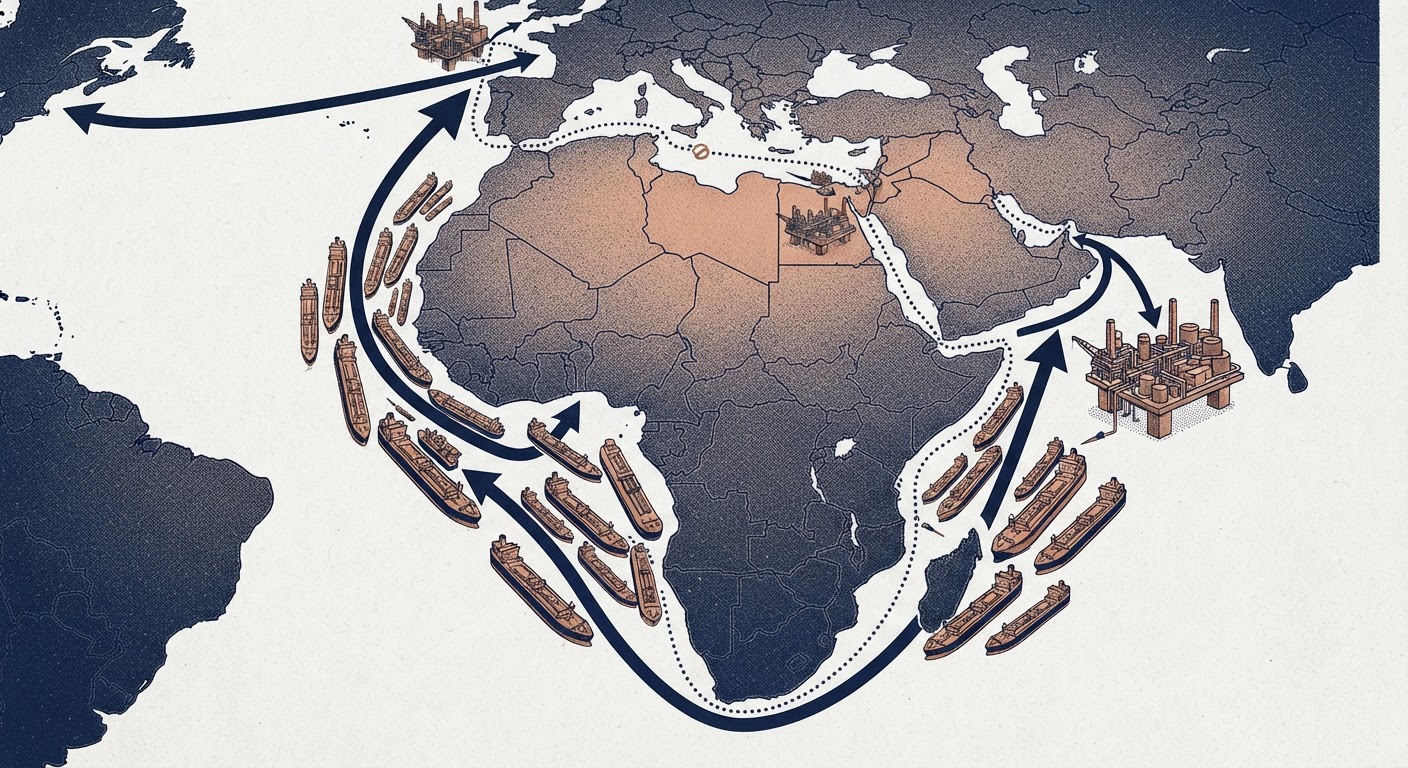
Saudi Arabia’s crude export rerouting could require an additional 36-40 very large crude carriers (VLCCs) as congestion at Gulf of Oman transfer hubs pushes operations further afield, according to Kpler analysis published by Hellenic Shipping News. The base-case estimate covers 3 million barrels per day of Saudi crude, with longer shuttle routes absorbing more ships for the same volume of cargo.
The analysis identifies transfer logistics, rather than available tanker capacity alone, as a growing obstacle to moving exports through eastern ports and the Strait of Hormuz. Shore-side support services at Fujairah and Sohar are reportedly operating at or near their limits. Kpler’s figures put Gulf of Oman liquids ship-to-ship activity at an average 3.7 million barrels per day since the US-Iran war, against 0.16 million barrels per day in 2025. These transfer totals do not necessarily represent distinct cargo volumes passing through the strait, because barrels can be transferred more than once.
India’s west coast, particularly the Kutch and Mumbai lightering areas, offers the closest alternative, although monsoon disruption restricts expansion. Recent growth there has mainly involved clean products, while most crude transfers remain linked to deliveries for local refiners. The analysis suggests shifting some Gulf of Oman clean-product transfers to India could release regional capacity for crude. Malaysia’s Pelepas and Linggi lightering areas offer another option, with Malaysian crude transfer activity reaching 1.7 million barrels per day in July.
Distance materially changes the fleet requirement. Hellenic Shipping News reported Kpler’s observed Gulf of Oman round trip at 17 days, compared with 21 days for west coast India and 38.5 days for offshore Malaysia. For the Saudi rerouting scenario, the estimated additional requirement rises from about 25 VLCCs using Gulf of Oman transfers to 32 using India and as many as 58 using Malaysia. The existing VLCC shuttle fleet is estimated at around 54 ships.
Kpler’s base case assumes operational improvements and prioritising crude over products can together accommodate another 1 million barrels per day in the Gulf of Oman. India would handle a further 0.5 million barrels per day of crude, alongside displaced product transfers, leaving remaining volumes for Malaysia or direct voyages. The resulting 36-40-vessel requirement would expand fleet exposure to Middle East Gulf risks, which the analysis links to the sustained freight rally of recent weeks.