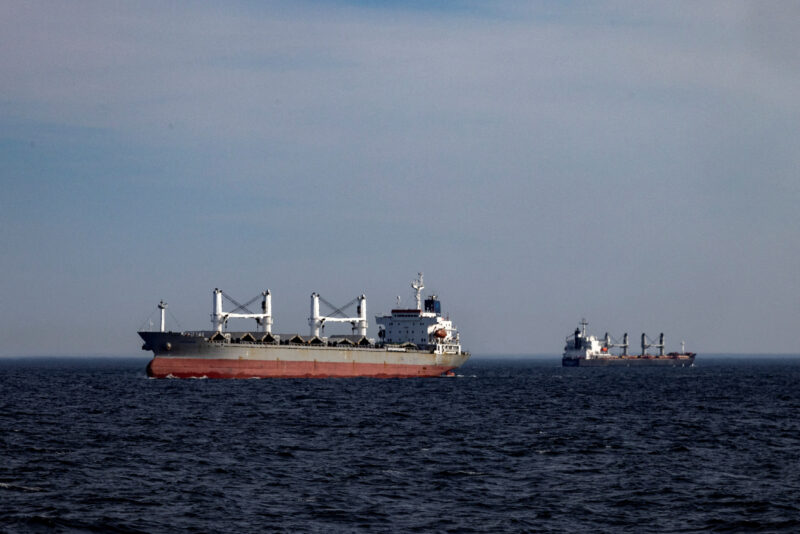
Disruption to Black Sea grain exports has left around 80 vessels waiting near Ukraine’s Danube ports as shippers seek alternatives to the country’s deep-sea terminals, gCaptain reported, citing vessel-tracking data compiled by Kpler and Bloomberg. The queue consists mainly of smaller ships, while low Danube water levels are complicating efforts to increase exports through Romania’s Constanta port.
The Bloomberg report published by gCaptain said Russian and Ukrainian attacks on ports had intensified since July, damaging grain terminals, storage facilities and vessels. Russia’s grain exports have been constrained by Ukrainian drone attacks, while Ukraine is attempting to move supplies through river and overland routes as its ports remain blocked. Attacks on Russian energy infrastructure have also pushed diesel prices to record levels, adding to farming costs.
Russia and Ukraine account for more than a quarter of international wheat trade. Their combined wheat exports for the July-September harvest period are estimated at around half the previous year’s level, according to SovEcon figures cited in the report. Wheat prices have reached three-year highs, while Egypt, the largest wheat importer, has gone about a month without receiving Black Sea grain.
Alternative corridors offer limited relief. Ports around Odesa normally handled roughly 90% of Ukraine’s grain exports, while current railway border capacity allows about 180 grain wagons, equivalent to approximately 10,000 tonnes, to cross daily. Routes along the Romanian and Bulgarian coasts are also becoming congested. Ukraine’s storage capacity could be exhausted by early November as the harvest accumulates, the report said.
Russia is directing grain through Kazakhstan, the Baltic and Caspian seas and its Far East. However, longer rail journeys raise transport costs, and increased Russian transit volumes have prompted Latvia and Lithuania to consider restrictions. Moscow plans to suspend grain export duties and provide subsidies for rail movements to alternative ports. More than 70% of Russia’s grain exports nevertheless pass through the Black Sea.
Buyers are seeking replacement supplies further afield. Vietnam’s Golden Wheat switched two cargoes to Bulgarian wheat loaded at Burgas and sourced US wheat to replace two other missing or delayed shipments, at considerably higher cost. Other importers have approached suppliers in France, the Baltic states and elsewhere, although drought damage in the US and heat-related losses in Europe are limiting available alternatives.